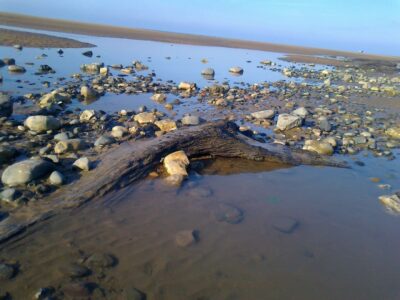
Sometimes, at low tide, you might see the tree stumps and trunk remains of a petrified forest on Cleveleys beach. Above photo: thanks to Andy Ball
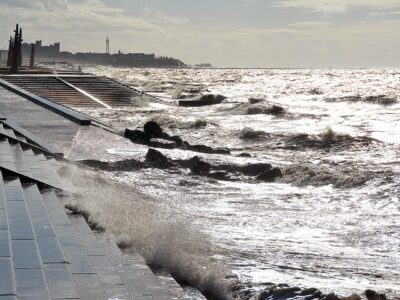
Our beach at Cleveleys moves around in time to the tides. Calmer seas and gentle breezes enable the sand which is carried by the sea to be deposited. Then rough weather and choppy seas scour the seabed and sand is carried away by the tide.
Petrified Forest on Cleveleys Beach
After rough weather, on the lowest of tides as far out as the sea goes, you might be lucky enough to see some of these tree remains from hundreds of years gone by.
You’re most likely to see it at very low tide, straight from the end of Cleveleys high street, particularly after a storm. If you do go a long way out on the beach, please be very careful and watch for incoming tide and channels/sandbanks. Check tide times first, and take a mobile phone.
This is one of the first vlogs we made, filmed in April 2020 when the country was in the first Covid lockdown.

Enjoyed this video? Why don’t you subscribe to our Visit Fylde Coast YouTube channel – make sure you don’t miss out!
The petrified forest is just one of the local legends in these parts. It’s immortalised in the The Sea Swallow – our local story book and seafront artwork trail.
FREE Newsletter
FREE Newsletter

The petrified forest isn’t to be confused with the thick, wide, brown spongy mass in the next photo. Stretching from right to left across much of the beach, these are Honeycomb Worm Reefs.

History of the Petrified Forest on Cleveleys Beach
The remains of petrified forest on Cleveleys beach are part of local folklore. It dates back to prehistoric times, like many others found all around the shores of the UK. Sea levels were much lower back then, and the country covered in trees.
Most people with an interest in the area have a knowledge of the petrified forest. Maps dating back to 1610 show prehistoric peat offshore.
Around 1788 the sea’s said to have gained three yards of land every year. That’s a lot of what used to be land, now submerged under a watery world. And with it, local villages are said to have been inundated by the rising sea levels.
And a sunken village?
It’s widely believed that there may have been a sunken village off the coast of Cleveleys. Lost from a time long before the modern concrete sea defences which protect us today. So the story goes, with the power of the sea going unchecked, the inhabitants of this village called Singleton Thorpe had to flee from flooding.
Fact and fiction
Whether it’s true or not, there was, however, an inundation in the mid 1500’s. Widely thought to have been one terrible night in September of 1554/5, but few people wrote back then so evidence is sketchy.
It’s thought that a storm surge, or even a tsunami, hit the West Coast in or around that year. It destroyed 12 villages between Carlisle and Southport. Three of them here on the Fylde Coast.
- Take a look at this article – Rising sea levels – are they fact or folklore? It’s a fascinating piece of research and thesis by Imogen Lyons, a Lancaster University student.
If you find this kind of local history interesting, join the Thornton Cleveleys Past Facebook group. You’ll learn the most amazing things about this area.
Your Sightings of the Petrified Forest on Cleveleys Beach
Beach levels rise and fall frequently, so the petrified forest isn’t always visible when you go out on Cleveleys beach at low tide. You’ll stand a better chance of seeing it after rough wintery weather. Rough seas often erode the sand, to leave the stumps and trunks visible.
In January 2018, Andy Blundell sent in these amazing photos showing the stumps and trunk remains of the petrified forest on Cleveleys beach –

These photos are from roughly opposite the end of Beach Road.


Alison Wilkinson sent in the photo below –

And this photo is from Andy Ball –

Your sightings of the petrified forest
James Turner, who enjoyed metal detecting, got in touch back in 2013. He wasn’t looking for pound coins and things with monetary value, but the history and heritage of the Fylde Coast.
James provided this information:
“What is for sure is that just about half way between the low and high water mark, out from present day Cleveleys, there was a forest. Some time after the above event occurred, whatever that event was, the sea again receded a little. It went back to the coast line we know today but still covered the forest when the tide came in. Sand built up around the tree trunks, the tops rotting away, leaving only the petrified stumps, visible now at low water. Sand movements may cover or uncover these remains depending on tides and weather. A big tide with gale force winds will more likely move sand on the beach.”
Silver Birch
Ivy also got in touch. She says “It was in the mid 80’s after a fierce storm. Our two lads and my husband went on the beach to find that lots of sand had scoured away.
“This had uncovered lots of tree stumps and tree trunks. One was silver Birch. In the original ground there were horse hoof prints. They found a cast horse shoe which we still have, although we don’t know how old it is.”
Why does the beach move about so much?
The combination of different weather and environmental processes makes beaches change dramatically, often from day to day.
The modern sea defences and stone groynes aim to reduce the energy of the waves close to shore. Reducing the turbulence in the water reduces the scouring effect and helps to maintain higher, stable beaches closer to shore. The beach material dissipates the energy of the sea, reducing the size of waves which can form, to reduce the risk of overtopping. That’s the aim of the Wyre Beach Management Scheme – nearing completion in 2025 at Cleveleys.
While you’re here…
Go to the homepage of the Visit Cleveleys website for the latest updates.
Enjoyed this article? Sign up for your email newsletter. Packed full of interesting things just like this it arrives in your inbox all 52 weeks of the year.
👉Join us on Facebook at our Visit Fylde Coast Facebook Group. Plus hundreds of videos to watch on our YouTube channel – from all over the Fylde Coast!
📣JOIN our new VFC WhatsApp Channel for what’s happening, interesting local information, history, communities, events and much more.
Booking a stay? Pick a safe, clean and legal place to stay, at the very best price. Book with the Visit Fylde Coast guide.

We Need Your Help
We Need Your Help