


There’s a great selection of Charity Shops in Cleveleys. But they’re like marmite – people either love them or hate them. Come and take a look at Cleveleys charity shops, and see how they’re doing a great job for people, the environment and the town!
Wide Range of Charity Shops in Cleveleys
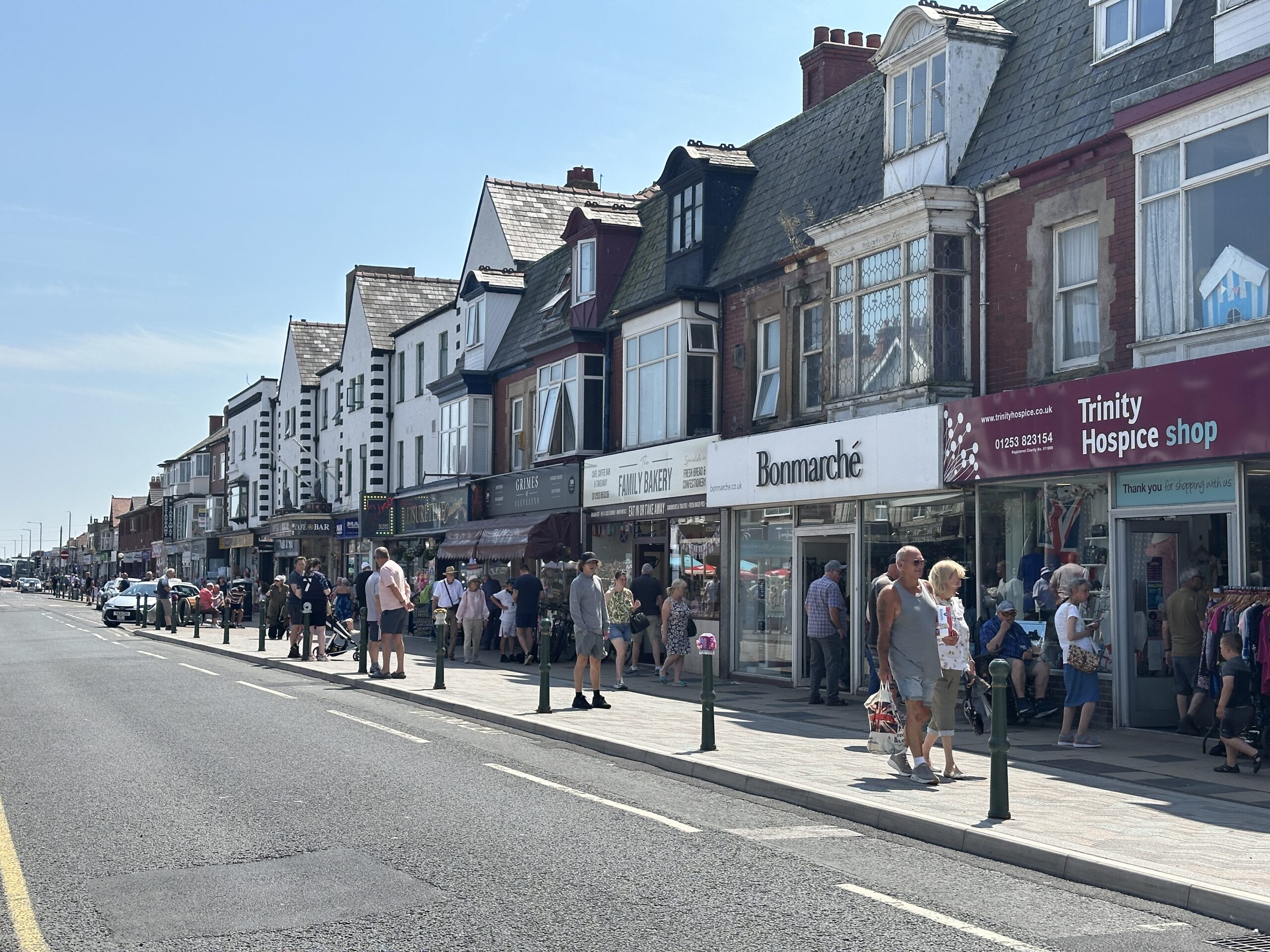
Our ‘little’ town centre isn’t actually as small as you might think it is. From end to end it’s actually longer in distance than Manchester’s Trafford Centre! And, just like most places these days, it has its share of charity shops.

There are stores raising funds for small, independent charities, like Trinity Hospice and Brian House. Plus shops run and managed by big national charities – for example Cancer Research, British Heart Foundation and Age Concern. Not forgetting, of course, the Care for Cleveleys Shop which raises funds to reinvest in our great town.
At the time of writing (February 2026) Cleveleys has these names. Get in touch if there are any missing!
- Brian House Children’s Hospice
- British Heart Foundation
- Cancer Research UK
- Care for Cleveleys
- Cats Protection (two shops)
- Easterleigh Animal Sanctuary
- Oxfam
- Regenerage Cleveleys
- Trinity Hospice (two shops)
The charity shops here in Cleveleys do all have one thing in common. They’re all well presented, attractive and well managed shops. At eye level (without looking at the name over the door) most of them look just like ‘normal’ shops. In fact most of them look far more attractive!
The Pros of Charity Shops in Cleveleys
There are a few charity shops at Cleveleys, and every time another one opens there’s a grumble from the public. But are they really such a bad thing? There are many positives about them – and yes, some are much better than others. These shops sit alongside occasional other community and pop-up charity offerings, but overall they form an important part of Cleveleys’ high street retail mix.
Charity shops are better than empty shops
We’ve been very lucky with our high street at Cleveleys in that it’s still varied and still thriving. But the retail landscape is changing all over the UK – the recession and online shopping were already pinching at retailers who are all competing in an overcrowded market. Lockdowns from the Covid-19 pandemic just put the top hat on it and sent shockwaves through the economy. As ‘quarter day’ arrives and rents are due, each time there seems to be a cull on the high street.
FREE Newsletter
FREE Newsletter

This leads to empty or boarded up shops, and in many high streets the charity shops take advantage and come to town. Their numbers are criticised, and there have been grumbles about them in Cleveleys. But are they really such a bad thing? The alternative to them would be those empty, boarded up shops.
By occupying retail space, charity shops avoid those ugly empty units that can make a town centre look unloved or declining. Instead, they help boost footfall, encouraging neighbouring shops and cafes to benefit from increased pedestrian traffic as people browse and shop locally.
They draw both local shoppers and visitors to the high street and maintain retail diversity and interest. In fact Cleveleys’ charity shops are noted as part of the town’s attractive retail landscape and often cited as a reason to visit the town and explore its bargains. Charity shops — especially community-run ones like Care for Cleveleys demonstrate community spirit, volunteer energy, and a collective commitment to improving the town.
Find a Quality Bargain
Let’s start with what we get out of them – us the consumer. In hard times, they provide somewhere to find more affordable things than you would otherwise get to buy new. Charity shops are a treasure trove of the unexpected – with brand name clothes, vintage treasures and all kinds of homewares.
Apparently shoppers complain about the price of things, expecting them for almost free. The Trinity Hospice shop has an answer for that – they say ‘We have an obligation to get a reasonable return for the donors generosity’. How very true. And at the end of the day, everything is going to go for far less in a charity shop than if you’d bought it brand new.
Reduce, Re-use, Recycle
Charity shops are not just retail spaces — they are drivers of sustainability. Because, just as important as their retail benefits, it’s a great way to recycle perfectly good things which might otherwise end up in landfill.

One of the most significant environmental benefits of charity shops is their role in reducing waste. Instead of unwanted items being thrown out or sent to landfill, they are donated, sorted, and resold. This reuse extends the life of items such as clothing, books, homewares, and furniture — preventing unnecessary waste.
According to organisations tracking second-hand retail, charity shops can reuse or recycle more than 90% of donated clothes and books, and over 85% of electrical items. This greatly reduces environmental impact compared with disposing of these items.
If you can find a new use for the things you don’t want, and save something from landfill by buying it, you’ve done a good deed. You know what they say, ‘one mans rubbish is another man’s treasure!’
Slowing Fast Fashion
The fashion industry’s environmental cost — particularly fast fashion — is huge. It’s so easy to go in Primark (and a hundred similar others) and fill a basket. By offering affordable, pre-owned clothing, charity shops help reduce the demand for newly manufactured items. In turn it cuts down on resource depletion, water use, and carbon emissions associated with producing new garments.
Beyond the environmental stats, charity shops help to bring sustainable mindsets into everyday shopping. When people browse second-hand racks, they engage with purchasing in a less wasteful way, reinforcing reuse as a cultural norm.
Charity shops provide affordable goods for residents and visitors alike. In times of economic pressure, affordable clothing, household items, and books make everyday life a little easier for individuals and families on tighter budgets, without sacrificing quality.
More people than ever are realising the impact that all of their ‘stuff’ has on the environment. Continually buying new things and disposing of them after one or two uses just isn’t a sustainable way for us all to live. Plastics don’t ‘disappear’ when we dispose of them – it all lingers on somewhere out of sight!
Repaying Kindness and Support
Then there’s the charity and goodwill side of it. Generally people tend to associate with a subject that they have experience of, which affects where their donations go and where volunteers aim for. For example if a family member has been treated at Trinity Hospice, people will volunteer for the shop because it’s a way of paying back the kindness and support that they’ve been shown. It’s certainly the experience of Cancer Research Cleveleys, with 60 volunteers regularly going through the doors.
Cancer Research is also stocked entirely from the goodwill donations to the shop from the generosity of local people in Cleveleys. That’s some achievement and if you’ve ever been in the store you’ll know it’s always fully stocked.
It’s the same story at Trinity – as a Fylde Coast charity with 11 shops across the coast, they also rely on local donations. While we were there, volunteer drivers turned up with an office collection from AXA at Lytham. (I’d have liked to look in the Hobbs bag!). They’ll sort through this stuff and then let the company know how much value there is in there. Many charity shops offer a collection service if you get in touch with them.

A new lease of life for the volunteers
Something you might have not even thought about is the volunteers who man the counter and take your money. What do they get out of it? Well it’s a productive use of their time, making people feel valued with an interesting task. It’s fabulous for people who might otherwise be isolated and alone. Charity shops are usually community hubs just as much as retail outlets.
Volunteers can be any age, from any background. Some are involved for a short period of time, others stay forever! It’s also a good way to fit a few productive hours into a week, without the commitment of paid work. Volunteering can also be a route into full time employment, which is how Lisa ended up running the Trinity shop. She told us, ‘looking after four kids was driving me mad so I went out doing voluntary work in a charity shop, got a paid position, and then moved into management’.
Volunteering offers people a way to stay socially connected, contribute to causes they care about, and build their confidence. It’s brilliant for your physical and emotional wellbeing – why don’t you try it!
The Care for Cleveleys Shop is a standout example. Situated in Princess Road, it doesn’t just sell goods — it serves as a community hub with space for workshops, meetings, coffee mornings, and volunteer engagement. The profits from this shop are reinvested directly into local projects and town enhancements, making it a true civic asset.
Raising vital funds
And finally, the whole point of the exercise, which is to raise funds for the charity itself. For many charities, retail income from shop sales is a major source of funding.
Maybe the shops are at fault for not making it clear where the funds go. But certainly Cleveleys Cancer Research, Trinity Hospice and the Care for Cleveleys stores are shining examples of your money being used locally.
Cancer Research funds are used within a 60 mile radius of Cleveleys, and go to Christies, Manchester University, Newcastle and Lancaster, to be used to fund vital research. Research which has found out all the things in recent decades that has helped thousands of people to survive what would once have been a death sentence. At Trinity, the monies raised are used to fund the Trinity adult hospice, Brian House children’s hospice, and the Lyndon Centre, which offers counselling not just to adults bereaved by cancer, but also to children across the Fylde, however their own tragedy struck.
Unlike commercial retailers, charity shops use volunteer labour and often pay minimal overheads. This means more of the income generated stays at the charity. Whether it’s for local causes or broader organisational missions, it means greater economic efficiency.
And the Cons of Charity Shops in Cleveleys
This page highlights just a few of the charity shop names in Cleveleys, but exactly the same theory could be applied across the board. There must be a demand for them and stuff must sell, or they wouldn’t exist! But, in the interests of balance, what are the downside of them?
Reducing the range of town centre shops
One of the main complaints when a new shop opens is that the space would be better used by a normal high street store. That’s true, but in a world of supply and demand, empty units are advertised and made available for anyone to lease. If a ‘normal’ retailer wanted to occupy it they would. The reality is that retail is a vulnerable game. There’s got to be enough demand in an area for a retail shop to survive – and the grim reality is that there often isn’t.
Creating an uneven playing field
According to the website charityretail.org.uk, Charity shops benefit from tax concessions under UK tax law. That’s because all the profits go to fund the work of the charity, which provides public benefit. Charity shops are taxed differently on profits, there’s a zero VAT rating on sales of donated goods and 80% mandatory non-domestic rate relief on property taxes.
When you consider how much work all of these charities do to support their various causes, this seems only fair.
However, an independent business operating in the same space would have all of those expenses and obligations to meet. And that explains why small independents need all the support we can give them.
In Summary…
Charity shops in Cleveleys are much more than places to pick up a bargain — they are ecosocial pillars that:
- Protect the environment by promoting reuse and reducing waste.
- Build community cohesion through volunteering, shared spaces, and support for local causes.
- Fuel the local economy by drawing visitors, preventing empty shops, and funding charitable missions.
- Enhance the town’s character and appeal, making Cleveleys a more sustainable and welcoming place to live, work, and visit.
Whether you’re a resident or visitor, Cleveleys’ charity shops exemplify the wide-ranging and tangible benefits that second-hand retail brings to towns across the UK.
What’s your view on them?
I regularly go in the Cancer Research shop – I buy Christmas cards and am a sucker for the cotton bags, buying almost all of them as they come out. I’ve had loads of odds and ends from there and find it a pleasant shop to shop in. Likewise, when I went in the Trinity shop for the first time I thought it felt like a chain store, never mind a second hand shop! If I see something in the window as I pass I’d definitely go in and take a look. I’ve had all kinds of things from all kinds of charity shops.
Then we opened the Care for Cleveleys Shop! We’ve been careful to make it look like a boutique. There’s no fusty smell when you walk in. Everything is clean, tidy and well presented. We’ve got a wide range of brand-new and handmade goods on offer. Everyone comments on what a lovely shop it is.
And the charity shops in Cleveleys have done very well out of us too! I must admit we have a bit of a hoarding problem here at Rabbit Towers 🙂 But eventually when the cupboards are full to bursting there’s only one thing that you can do and that’s have a clear-out. Bonanza time for the charity shops – I hate throwing things away that other people could use.
What do you think? Why don’t you join in the conversation and leave a comment below?
While you’re here…
Go to the homepage of the Visit Cleveleys website for the latest updates.
Enjoyed this article? Sign up for your email newsletter. Packed full of interesting things just like this it arrives in your inbox all 52 weeks of the year.
👉Join us on Facebook at our Visit Fylde Coast Facebook Group. Plus hundreds of videos to watch on our YouTube channel – from all over the Fylde Coast!
📣JOIN our new VFC WhatsApp Channel for what’s happening, interesting local information, history, communities, events and much more.
Booking a stay? Pick a safe, clean and legal place to stay, at the very best price. Book with the Visit Fylde Coast guide.

We Need Your Help
We Need Your Help






I have a brand new commode. 3 wheel walking frame with brakes Zimmer frame .thay was sent to my dad he will not use them I rang the person who sent them thay said thay can not take them back take them to a charity shop are you interested in them .
You’d have to check with the charity shop of your choice, Malcolm.