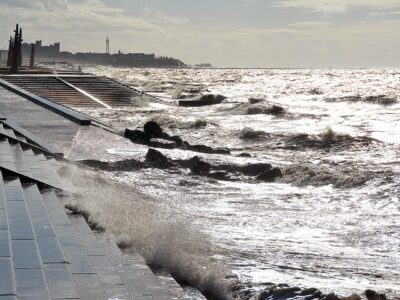
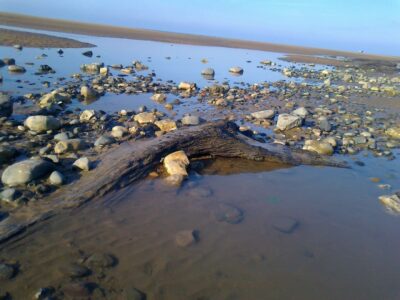
Do you remember a big ship landing on Cleveleys beach, to connect part of the Walney Offshore Windfarm to shore? It was 8 May 2011.
The high-voltage electricity cable runs under the sea wall and beach from the seafront at Rossall Beach, right out to the windfarm at sea. Beach Works and bringing the windfarm cable to shore was a big job in itself! For some time you could see the top of the sheet piles which marked where the works took place. Now covered, there’s no remaining trace of the work – except for an information board about it nearby.
It was mid March 2011 when work began at the beach on North/Rossall Promenade in preparation for the arrival of the submarine cable. A separate team of workmen known as the landfall team had already laid cables in the highway to the substation at Hillhouse Enterprise Zone. The land cables end in a joint bay on Thornton Gate, just where it turns the corner from North Promenade.
Now, a different offshore team installed the cable under the sea to low water mark. This page is about the bit in the middle. What’s called the ‘landfall interface’, and how the bit in the middle was managed.
Beach Works and Bringing the Cable to Shore
The project team had originally intended to drill under the sea wall and highway, from the beach to the excavation pit at Thornton Gate. For a variety of reasons, this plan was changed to an open-cut method. That’s exactly what it sounds like – a trench was dug so the cables could be laid across the road.
It was possible to auger-bore under the actual walls themselves, to minimise disturbance to the sea wall above. Most of the technical reasons for this change were to do with future-proofing the safety of the cable. Particularly if and when any sea defence work takes place here in the future.
Working on the Beach
The sea coming in twice a day is a big problem if you’re trying to work on a beach!
FREE Newsletter
FREE Newsletter

To create a safe, dry working space, the team first built a long, narrow cofferdam, running in a line with Thornton Gate. A cofferdam is a protected enclosure, built by knocking sheet piles vertically into the beach. Pumping the water out afterwards creates a dry, safe area for working in. Some years later engineers built another cofferdam nearby at Anchorsholme. That one enabled work on the new sewerage infrastructure, installed in Anchorsholme Park.


Like a knife into butter!
A piling rig vibrates the lengths of steel into the beach – like a knife going into butter. If the piles meet resistance from hard clay or rock they might need a final knock into place. Wondering how they get those long lengths of metal piles to line up accurately? Here’s a clip of how it’s done!

Enjoyed this video? Why don’t you subscribe to our Visit Fylde Coast YouTube channel – make sure you don’t miss out!
The cofferdam extended from the low re-curve sea wall to quite someway out into the beach.

Spanning the Sea Wall
A concrete-cased steel pipe was fitted in the trench from the excavation pit at Thornton Gate. It goes under the sea walls and promenade, down the beach to where the new design finishes. The concrete casing protects the steel pipe so there’s no possibility of disturbing it in years to come. You can see the steel pipe in this photo –

With the pipe installed and cast-concrete laid, the cofferdam was removed. Except the few sheets joined to the block of concrete with the steel pipe going through them at the seaward end. You can see them in the next two photos.


These piles were installed at a low level but you could still see their tops when beach levels dropped. That was until the Wyre Beach Management Project and the installation of new rock groynes to help maintain healthy beach levels. Now, there’s no sign of anything ever happening!


Crossing the Beach
A continuous, sealed plastic cable duct houses the cable itself. It’s deep under the beach from the sea wall – right out to the lowest of low water points. All this prep work had to be complete before the ship arrived with the cable. At the same time, other specialist engineers installed the turbines out at sea.

Installation of the cable in the beach is a fascinating process for anyone lucky enough to see it. It’s not every day that you see a great big ship parked on your beach! The Stemat Spirit cable laying barge was first seen just offshore in the afternoon of Saturday 7 May 2011.

Arrival of the cable barge on Cleveleys beach
The ship anchored as near to shore as it could get on the high tide in the early hours of Sunday morning of 8 May 2011. The tide went out to leave the ship sat high and dry on the beach! At about 9am on Sunday, the crew sprang into action and the process of pulling the cable from the huge spool on board the barge began.


Delivering the High Voltage Electricity Cable
A plough attached to the barge had already carved a 2m deep trench into the seabed. Next, the high-voltage cable was unrolled from huge spools at the back of the ship, dropped into the trench, then covered with sand. The marine cable is in one piece from the windfarm to land. It’s an armoured, high voltage 132kv power cable, complete with a 48 core fibre optic cable which provides communication to the windfarm.


Here’s a video showing some of the process. You can tell that 2011 was some time ago and we were using compact cameras, in the days before smartphones. The quality of the film isn’t very good!

Joining the Windfarm Cable to Land
The landfall cable runs under the highway from the joint bay at Thornton Gate, across the tramway and Amounderness Way to Fleetwood Road North. From there it goes along Trunnah Road to Hillhouse Industrial Estate. It delivers the electricity through a then brand-new substation, into the National Grid at Stanah.
So the next task on cable laying day is to get the cable from the barge to physically meet the cable already laid in the road. Actually joining the two cables together so that they conduct electricity is a technical and specialist piece of work. A few weeks later another team of specialist electrical engineers carried out this work. Under the cover of a tent over the joint bay, it took about a fortnight for them to complete all the wiring.

Finally, at the end of a long and tiring but successful day, the Stemat Spirit cable laying barge sailed off into the sunset.

Recording the Works
Visit Fylde Coast worked with DONG Energy throughout the duration of this project. We provided updates and information for the public and residents along the route in a portal on the Visit Cleveleys website. In addition there were letter drops, public meetings and more.
As we’ve upgraded our websites from version to version the content may have lost some of it’s formatting. You’re very welcome to take a look at the archive we saved if you’re interested.
- Take a look through this section about the Walney Offshore Windfarm.
- More about installation of the land cable here
- Keeping you informed
- Walney Windfarm Extension
While you’re here…
Go to the homepage of the Visit Cleveleys website for the latest updates.
Enjoyed this article? Sign up for your email newsletter. Packed full of interesting things just like this it arrives in your inbox all 52 weeks of the year.
👉Join us on Facebook at our Visit Fylde Coast Facebook Group. Plus hundreds of videos to watch on our YouTube channel – from all over the Fylde Coast!
📣JOIN our new VFC WhatsApp Channel for what’s happening, interesting local information, history, communities, events and much more.
Booking a stay? Pick a safe, clean and legal place to stay, at the very best price. Book with the Visit Fylde Coast guide.

We Need Your Help
We Need Your Help