Planning a day out on the Fylde Coast requires accurate, up-to-date Cleveleys tide times. Located between Blackpool and Fleetwood, Cleveleys boasts a dramatic seafront and a beach defined by vast tidal ranges, stunning coastal artwork, and vast sandy expanses. Here’s our complete guide to high & low water and coastal safety.
Cleveleys Tide Times: Complete High & Low Water Guide & Coastal Safety
Whether you’re walking along the promenade, visiting the iconic Mythic Coast artwork, sea fishing, or exploring the sands, understanding how the Irish Sea moves across Cleveleys beach is essential for a great day out—and for your safety.
And playing a big part of outdoor life at the coast, check out the weather in Cleveleys.
Daily Cleveleys Tide Times & Chart
Tides in Cleveleys follow a semi-diurnal pattern, meaning there are two high tides and two low tides every 24 hours. On average, the time between a high tide and a low tide is approximately 6 hours and 12 minutes.
Tip for Visitors: Always check dynamic, real-time tide tables before stepping onto the beach. Times shift by roughly 50 minutes each day due to the lunar cycle.
Check out the Visit Fylde Coast Weather Guide – it includes tide times, forecast and webcams in one handy page. You could do an internet search for todays tide times, or download an app onto your phone. The best time to explore the lower reaches of beach is to follow the tide out. As it turns and goes out, follow the retreating sea. This way you will get the maximum amount of time at low water before it turns and starts to come in again.
Average Tidal Heights at Cleveleys
- Spring Tides (Highest Highs / Lowest Lows): High tides can reach 9.5 metres to 10+ metres above Chart Datum.
- Neap Tides (Smaller Variation): High tides peak around 6.5 to 7.5 metres.
- Low Water Range: Varies between 0.5 metres (extreme spring tides) and 3.5 metres (neap tides).
Essential Beach Safety: What You Must Know Before Walking Out
Promenade highlights, the Mythic Coast, sunsets and photo spots are all great things to know. But above all you MUST keep safe. The Irish Sea on this stretch of coast moves in rapid tides and there’s a real risk to life if you get it wrong.
1. The Threat of Sandbank Isolation
The foreshore at Cleveleys is exceptionally flat. As the tide comes in, water does not just advance in a straight line from the deep sea—it fills low-lying gulleys, channels, and hollows behind higher sandbanks first.
- Walkers out near the low-water mark can easily become surrounded by deep water while still standing on dry sand.
- Safety Rule: Always begin your walk back toward the sea wall at least 2 hours before high tide.
2. Rapid Ingress Speed
Because the beach gradient is so shallow, the incoming tide at Cleveleys moves faster than normal walking pace, especially during spring tides. Never attempt to outrun an incoming tide through waist-deep gulleys.
FREE Newsletter
FREE Newsletter

3. Sea Wall and Steps Access
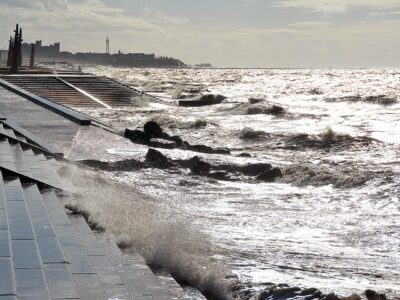
Cleveleys features a stepped sea wall built as part of its coastal defence system. At high spring tides, the Irish Sea reaches all the way to the foot of the stepped promenade, leaving zero sand exposed. There’s almost always some shingle beach exposed at North/Rossall Promenade between the seafront cafe and Rossall School. It rarely covers here, except during very stormy weather.
- Ensure you know where the nearest access ramps or stepped exits are located before walking out.
- During stormy conditions, high tides cause sea spray and large waves to break over the promenade. Avoid walking near the edge during overtopping warnings.
4. Rocks – Revetment and Groynes
Completed in 2026, the Wyre Beach Management Scheme included protection for the sea wall and constructions of a groyne field. The purpose is to stabilise the beach and in doing so reduce the risk of overtopping and erosion. Opinion is divided about the aesthetics of this human intervention.
The rocks are there for an important purpose, but they also add interest and habitat to the beach. Enjoy searching the rockpools for wildlife and using the groynes as windbreaks. But please do not climb on the rocks. Covered in seaweed and algae they are slippery, and voids between them dangerous.
How Tides Affect the Mythic Coast Sculptures at Cleveleys
Cleveleys promenade is famous for the Mythic Coast trail—a series of striking public art installations based on the storybook The Sea Swallow. The tide dramatically changes how you experience these sculptures:
| Artwork | Location | Best Tide to View |
| Mary’s Shell | On the beach, opposite Jubilee Gardens and adjacent to the seafront cafe. | Low to Mid-Tide — Fully exposed at low water so you can walk inside it. At high tide, it’s either surrounded by water or submerged. You’ll usually be able to see some or a small part of it, rising above the waves. |
| The Ogre | Offshore on the beach, in a small rock maze opposite Andrew Mellor Vets (formerly the Harvester pub). | Low Tide — Emerges from the sea as the water retreats; recedes back under water as high tide approaches. At high tide the Ogre is completely submerged. |
| The Ogre’s Paddle | On the upper promenade, opposite JD Gym | Anytime — Positioned safely above the high-water line. |
| The Shipwreck Memorial | On the promenade at Kingsway – the boundary between Blackpool and Wyre/Cleveleys. | Anytime — Located on the promenade overlooking the ocean. Look south through the hole to see the wreck of the Abana. |
| The Sea Swallow | On the upper promenade at the Plaza, at the end of the main shopping street. | Anytime — The tall, white Sea Swallow sculpture is a marker for the beach. Visible all around, even as far inland as the roundabout at Morrisons. |
Best Times for Activities at Cleveleys Beach
Beachwalking & Dog Walking
- Best Window: From 2 hours after high tide until 2 hours before the next high tide.
- Dog Restrictions: Seasonal dog bans apply on the main beach section between May 1st and September 30th (from the Cafe to the beach access opposite Jubilee Leisure Park). However, dogs are welcome year-round north toward Rossall Beach and south toward Bispham.
Sea Fishing
Cleveleys is a renowned spot for shore angling, targeting codling, whiting, flounder, bass, and rays depending on the season.
- High Tide Fishing: Anglers often fish off the sea wall 2 hours before to 1 hour after high tide. Exercise extreme caution during wind-driven spring tides.
- Low Tide Bait Digging: Low spring tides expose vast mudflats rich in lugworm and ragworm. Always carry a compass or GPS app, as sea fog (fret) can descend rapidly.
Photography & Sunset Spotting
- Low Tide: Ideal for capturing reflections of Mary’s Shell in coastal pools.
- High Tide: Perfect for long-exposure photography of waves crashing against the stepped revetments and rock groynes.
Local Parking, Access & Facilities
When planning your visit around tide times, access and amenities vary depending on where you land:
- Main Plaza & Promenade: FY5 1BS (Pay & Display parking at Derby Road and Jubilee Gardens). Direct ramp access down to the sands.
- Rossall Beach (North): FY5 1LP (Free road parking along North Promenade). Stepped access to the beach. Excellent spot for observing pebble-ridge marine habitats.
- Public Toilets: Located at the seafront cafe near Jubilee Gardens, and at the Bus Station on Victoria Road West.
- Tide Information Boards: Physical tide predictions are updated daily near the seafront promenade office and local beach watch stations. Pollution information is also provided.
Cleveleys Coastal Emergency & Contact Information
If you see someone in difficulty on the beach, in the mud, or cut off by the tide:
- Emergency: Dial 999 immediately and ask for the Coastguard.
- Primary Lifeboat Station: RNLI Fleetwood (operating all-weather and inshore lifeboats covering Cleveleys waters).
- Local Coastguard Team: HM Coastguard Fleetwood.
Frequently Asked Questions (FAQ)
What is the tidal range in Cleveleys?
Cleveleys experiences one of the largest tidal ranges in the UK, often exceeding 10 metres during spring tides.
Can you walk to Mary’s Shell at high tide?
No. At high tide, Mary’s Shell is either completely surrounded by the sea or submerged depending on the height of the tide. You should only approach the shell at low water or mid-tide while the sea is retreating. You can see parts of it from the safety of the promenade footpath when it’s submerged at high tide.
Is Cleveleys beach sandy or pebbly?
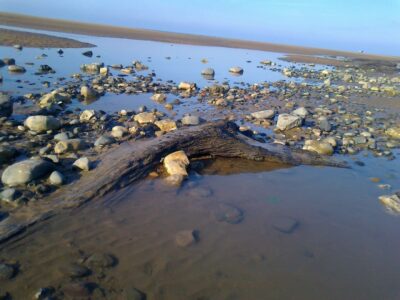
The upper beach near the sea wall consists of shingle and pebbles. As the tide goes out, vast expanses of fine sand are revealed.
Is it safe to swim at Cleveleys?
While swimming is permitted, there are no RNLI lifeguard patrols stationed directly on Cleveleys Beach. Swimmers must contend with strong lateral currents, low water temperatures, and fast-moving tides. Caution is strongly advised.
There is also a digital display above the public toilets in the seafront cafe building. This provides advice about current pollution incidents and whether swimming is advisable.
While you’re here…
Go to the homepage of the Visit Cleveleys website for the latest updates.
Enjoyed this article? Sign up for your email newsletter. Packed full of interesting things just like this it arrives in your inbox all 52 weeks of the year.
👉Join us on Facebook at our Visit Fylde Coast Facebook Group. Plus hundreds of videos to watch on our YouTube channel – from all over the Fylde Coast!
📣JOIN our new VFC WhatsApp Channel for what’s happening, interesting local information, history, communities, events and much more.
Booking a stay? Pick a safe, clean and legal place to stay, at the very best price. Book with the Visit Fylde Coast guide.

We Need Your Help
We Need Your Help