

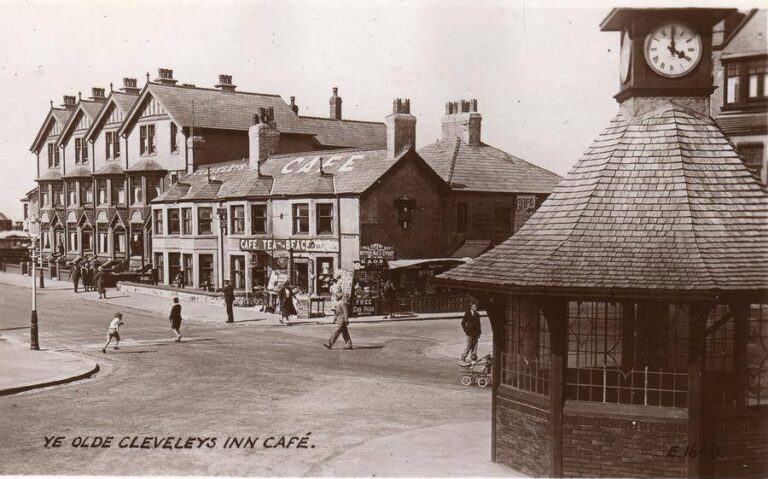
It’s a special little building in the little roundabout at the seaward end of Cleveleys high street. And it’s much loved by the local community. We’ve set out to find out more about the history of the clock shelter.
What do you know about this Buildings Past?
What is the history of the clock shelter? Who built it? Exactly when was it put in the roundabout? We want to hear it all. Not just to preserve the shelter as it stands, but also to collect and preserve it’s past too. It’s part of the history of Cleveleys!
- Have you got any old photos of that spot as it once was, and photos showing the origins of the shelter?
- Have you got memories of the shelter when you were little? From day trips or maybe from climbing into the rafters?
You might remember the community campaign which Visit Cleveleys led, to restore the clock shelter. That was back in 2014.
Grateful thanks go to all of the local historians and ‘Past’ Facebook Groups who have already provided information about the history of the clock shelter.
History of the Clock Shelter
The restoration campaign in 2014 sparked a renewed interest in the Clock Shelter. Collectively we tried (and pretty much failed!) to find out when and why it was built, and to locate any photos from the time.
Back in 2014 we seemed to draw a blank. But thanks to local historian Nick Moore, and the good people of the Thornton Cleveleys Past Facebook group, we managed to find out more about its origins.
Building the Clock Shelter
Nick is author of a fascinating encyclopedia of Fylde Coast history which you can read/search here. His work explains the origins of the shelter and its clocks.
FREE Newsletter
FREE Newsletter

In May 1927 the towns of Cleveleys and Thornton had been amalgamated. The new Cleveleys promenade opened on 17 September 1927. The shelter was added in 1928 to complete the new promenade, together with electric lighting, but we don’t have an exact date.
A time capsule was placed inside the foundation stone of the new promenade by Councillor Rowbotham. It was a small monument at the top of Kingsway, about 4 feet high. The lead-lined, sealed oak casket contained posters, town planning maps, and newspapers. Unfortunately, it was opened and emptied in the 1980s, before the monument was moved to the Blackpool boundary.
Bill Moorcroft is another knowledgeable local historian. He shared this snippet about Cleveleys Promenade from the Gazette & Herald of 28th July 1928.
“The artistic rockery seats have recently been made even more attractive by the ornamental electric lamps placed in the centre of them. At the top of Victoria Road, near the shore, an artistic shelter is shortly to be erected, and is to have a clock affixed. When this is done the entrance to the Promenade will present a pretty appearance and will be a credit to the local authorities.”
It was Dave Hutchinson (now sadly deceased) who came up trumps and found us a photo of Victoria Road West in his collection – without the clock. Take a look at this!
Do you have any other information to add?

The History of the Clock Shelter pre 1950’s
Here are some of the earliest photos of Cleveleys clock shelter that you’ve been able to find.


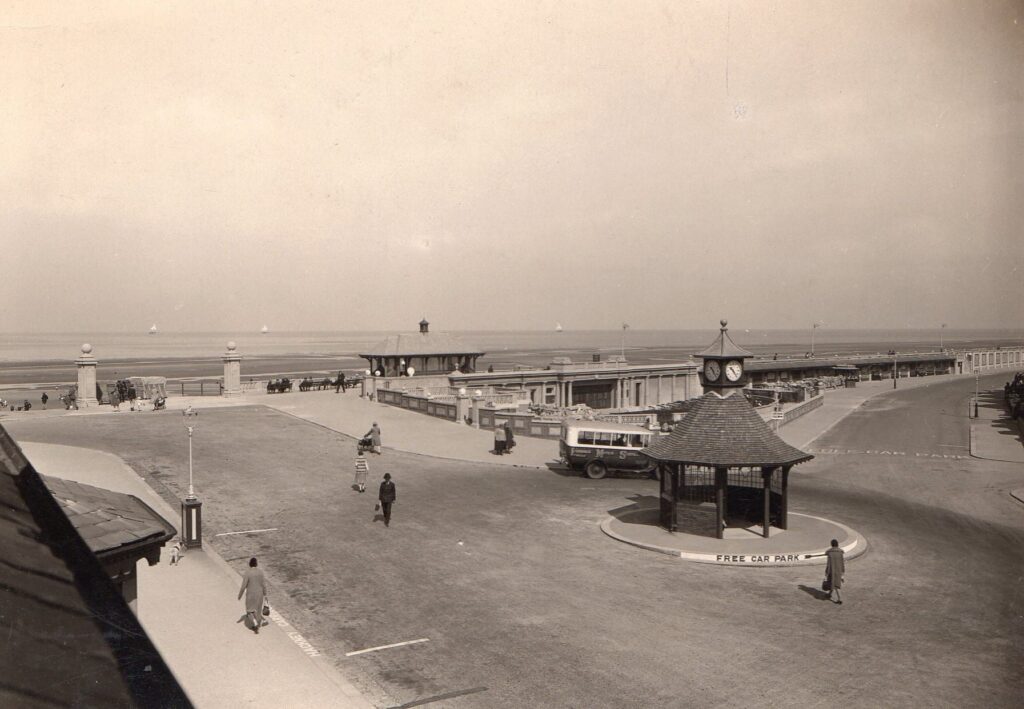
The photo below dates from 1937 and was also provided by Andy Ball. In it you can see that there was originally a gutter on the building, supported with fancy finials.


Here’s another undated, but excellent photo, also supplied by Andy Ball. Judging by the clothes and the vehicle, it’s probably dating to around the 40’s. But, this is just what the promenade looked like up to the point when the current sea defences were built.
History of the Clock Shelter in More Recent Times – 1950’s onwards
You could say that the Cleveleys we know started to grow from the 1950’s onwards. This is another photo from Dave Hutchinson, showing guest houses which were later demolished. Now it’s the site of the ice cream parlour and gaming shop.

Tony Bowker told us that he used to help his grandfather wind the clocks. He also supplied this bit of history about the boarding houses:
“One of the demolished boarding houses was run by my Grandmothers aunt. She came here from Tunstall in Staffordshire with my father (aged four) and two aunts, after her first husband died in around 1907. This is where she met my grandfather who looked after the clocks in later years, after the second world war..”
What’s in a Name?
The clock shelter seems to have had a few different local names over the years.
Pete John Smith told us that it was known as the birdcage back in his youth, and the ‘four faced liar’. That particular nickname was because the four clocks often told a different time!
This photo was sent in by Pete Skinner (also now sadly deceased), taken during a rainy weekend in 1975. Note that the clocks look to be complete, there’s glass in the windows and it’s still got its drainpipes.

The 1980’s – When the Clocks Went Missing
Tony Bowker got in touch with his anecdote. “I’ve lived in NZ for over 50 years, but remember the clock tower from my earlier days. My grandfather, Havelock Bowker, lived in York Avenue and had the job of keeping the clocks serviceable.
“In the late 1940’s I used to feel very important walking up Victoria Road carrying the ladder that my Grandfather used to get up into the clock tower loft. He used to go regularly to wind the clocks and make sure that they were OK.
“He died in 1964 so certainly he wouldn’t have had any idea where the clocks disappeared to. I know the clocks were there in 1948. I don’t have any photos but I have a postcard from the 1980’s and the clocks were missing then.”
Thank you Tony, for another piece of the jigsaw of the history of the clock shelter.
Exactly when did they go missing?
The next photo came from Peter Ford and dates back to the 1980’s. The guest houses are still standing (pre the ice cream parlour and gaming shop) but the clocks have gone AWOL. And look at the alignment of the road! Victoria Road West skirts past the side of the clock which sits on two give-way junctions. The current roundabout arrangement must be fairly recent.
Do you know what year the guest houses were demolished? That date gets us closer to dating the disappearance of the clocks.

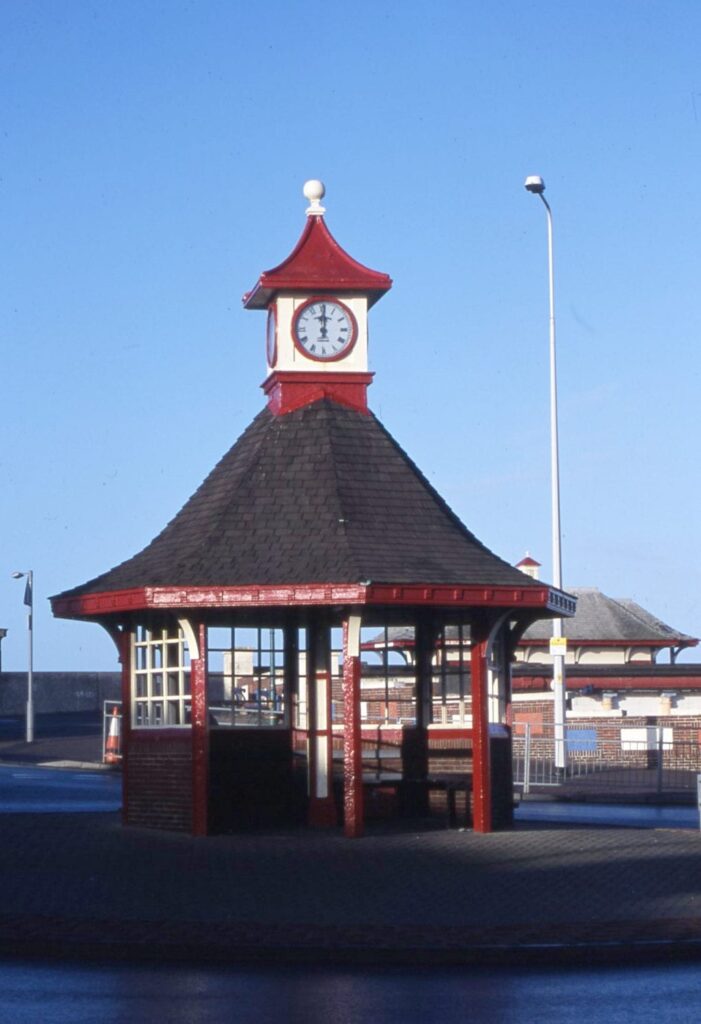
The next photo is one of ours from the Visit Cleveleys archive, taken before the new sea defences were built. Unfortunately it’s not quite at the right angle to see whether the other clocks are missing, but it’s painted in the same colour scheme as the photo above.
It’s interesting to look back at the history of the clock shelter and the promenade and see how things have changed.
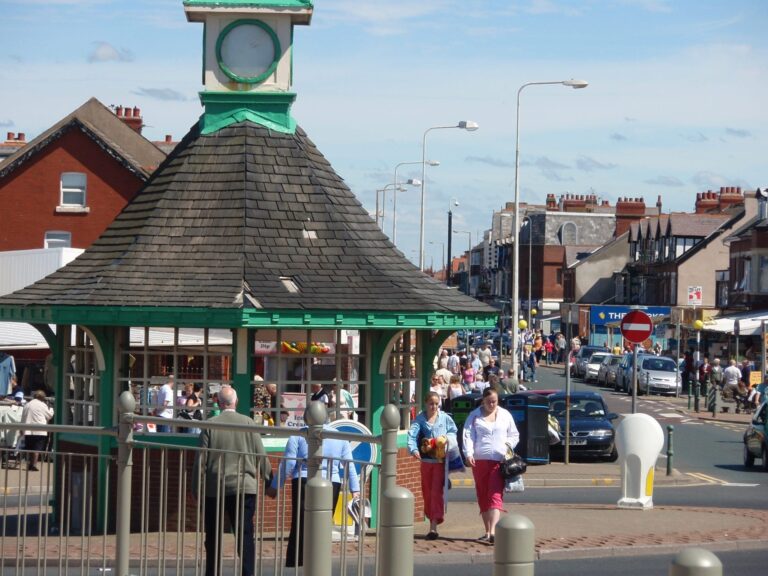
The last time the Clock Shelter was Green
These photos are also from the Visit Cleveleys archive, taken in July 2008. Next time it was repainted the colour scheme was changed to black and cream.

More to our Clocks than Meets the Eye…
Well, well, well. It seems that our one shabby clock in the town centre roundabout on Victoria Road West might be a little treasure after all.

The company which made our original clock was started by William Potts, born in 1809. Growing and expanding, it was awarded a Royal Warrant by Queen Victoria in 1897, then renamed William Potts & Son when three of his sons joined the business. After the First World War two sons left to start their own businesses. William Potts and Sons joined the Smith of Derby Group in 1935, but kept the name.
More than 1600 of their clocks are believed to still be in existence. There are various notable examples, including Edge Hill railway station in Liverpool. So there you go, there’s more to the history of the clock shelter than we thought.
History of the Clock Shelter – the 2014 Restoration
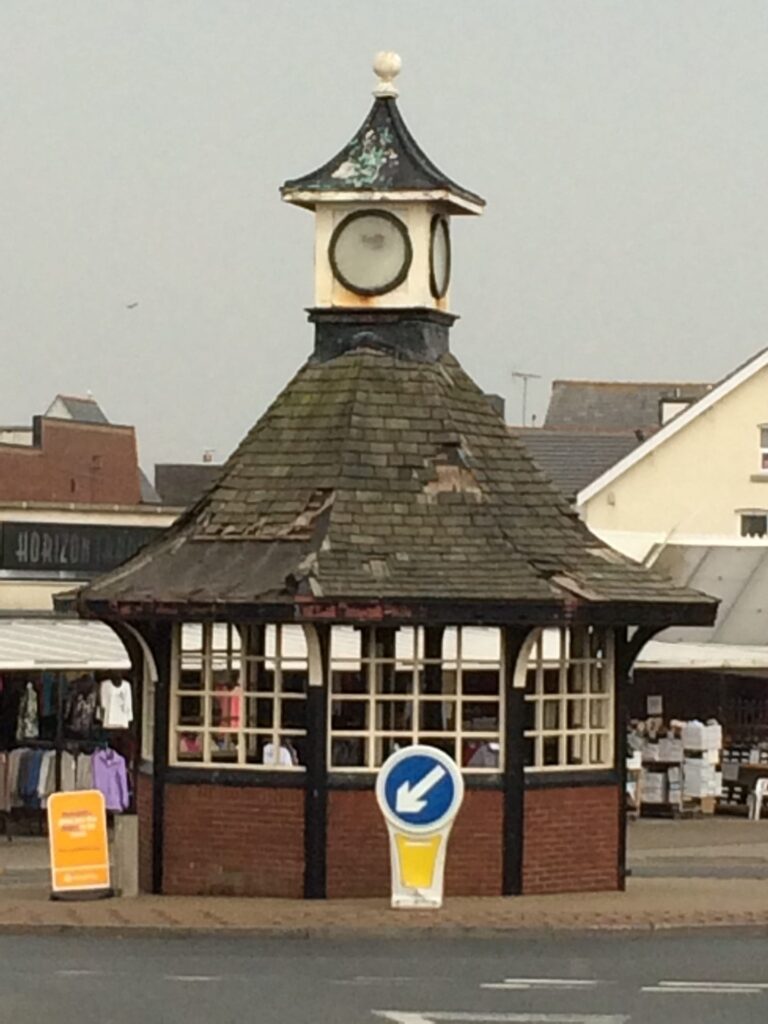
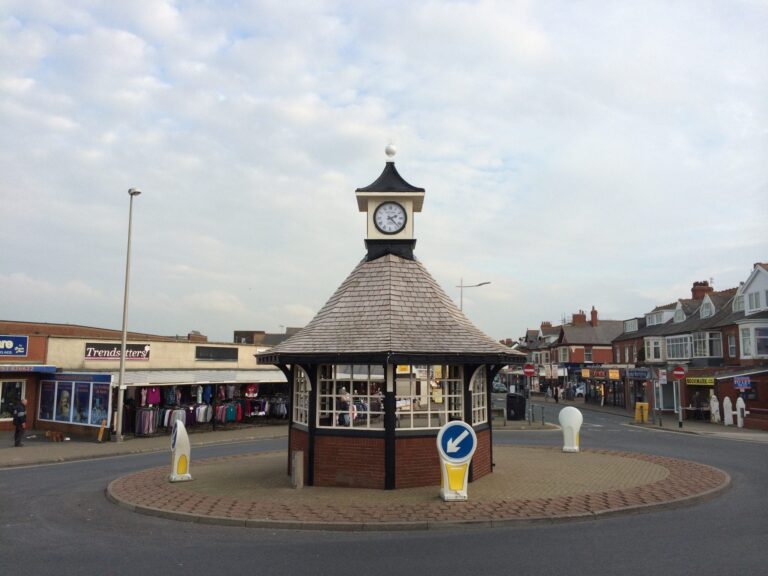
In 2014 our well loved clock shelter was looking really worse for wear and storm damage had taken its toll. So here at Visit Cleveleys we decided to do something about it. We started a community campaign to save and restore it. Between us all we secured the future of one of the last remaining heritage assets in the town.
This is what it looked like before we all rallied round and saved it…
And this is what it looked like afterwards… It’s another chapter in the history of the clock shelter. What chapters will be written for it next?
- Find the full Save our Clock Shelter Campaign here
While you’re here…
Go to the homepage of the Visit Cleveleys website for the latest updates.
Enjoyed this article? Sign up for your email newsletter. Packed full of interesting things just like this it arrives in your inbox all 52 weeks of the year.
👉Join us on Facebook at our Visit Fylde Coast Facebook Group. Plus hundreds of videos to watch on our YouTube channel – from all over the Fylde Coast!
📣JOIN our new VFC WhatsApp Channel for what’s happening, interesting local information, history, communities, events and much more.
Booking a stay? Pick a safe, clean and legal place to stay, at the very best price. Book with the Visit Fylde Coast guide.

We Need Your Help
We Need Your Help




Further to my recent comment, regarding the photo of the clock shelter with ‘Childrens Corner’ in the foreground; whilst Masons Amusements website states that Masons took over the Arena in 1966 from the council to establish Childrens Corner on the site, I have seen it elsewhere on the internet (i.e. tripadvisor) that there has been a Kiddies Corner on the promenade at Cleveleys since 1961. and from my own early memories, i tend to favour the 1961 date rather than 1966. Can anyone confirm this? I wonder if 1966 was when Masons changed the previous kiddies’ car ride (with cars that I remember as being similar to ones at Corrigans in Fleetwood) to the well-known ‘vintage cars’, that remained an attraction at Kiddies Corner aka Childrens Corner aka The Arena for several decades, as well as the ‘Alpine Glide’ (helter skelter) !!
Great piece on the history of the clock shelter, with some really evocative photos. I particularly like the colour photo supplied by Dave Hutchinson, entitled ‘Cleveleys promenade and clock shelter in the 1950’s’. I do, however, contest the date of this photo. The photo comes from a postcard in the Colourmaster series, published by Photo Precision Limited, St Ives, Huntingdon, reference no PT19333, described as ‘Victoria Road, Cleveleys’. Whilst most of the cars do appear to be models produced from the mid-1950’s to mid-1960’s, my reasons for doubting that this is a 1950’s scene are twofold: Firstly, on close inspection, you will note double yellow lines painted along the edge of the road. According to Wikipedia, double yellow lines were first introduced in the UK by section 51 of the Road Traffic Act 1960. Secondly, you will note merry-go-round and candy floss booth in ‘the area known as ‘Children’s Corner’ in the foreground. however, in the ‘Our History’ section of the Masons Amusements website, it is stated that Masons took The Arena off the council’s hands in 1966 to establish Childrens Corner on the site. This then suggests the scene is more mid -1960’s than 1950’s!! Can anyone add to this?