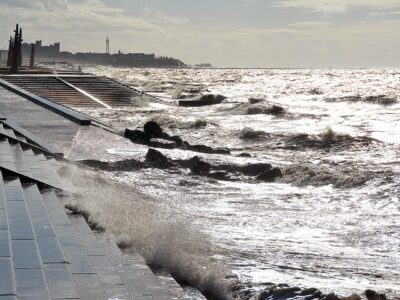
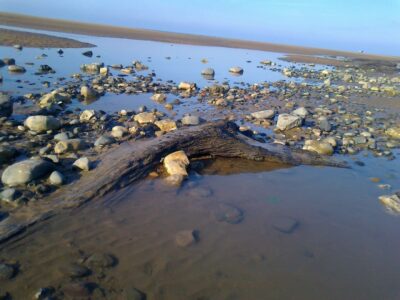
The Fylde Coast has claimed many a boat and ship over the years – the Shipwreck Memorial at Cleveleys seafront is testimony to this. Some of them have come a cropper in living memory – for example the grounding of the Holland XXIV Dredger at Cleveleys in August 1981.
Grounding of the Holland XXIV Dredger at Cleveleys
“One of the most dramatic incidents in recent memory was back in August 1981, when strong winds and mountainous seas left the 5m Anchorsholme sewage pipe project in ruins. The giant Holland XXIV dredging platform and two supply platforms were beached and wreckage was scattered for half a mile along the Cleveleys shore. The seven-man crew had moved the 150-ton dredger half a mile north in a bid to stop the other non-powered rigs from going ashore. Engineers and council officials counted the cost of the destruction and the launching of the giant pipeline, replacing a 40-year-old outfall, and designed to stop raw sewage being washed up on Fylde beaches, was postponed until the end of the month.” From 28dayslater.co.uk
August Storms
Back in the summer of 1981, a new 5m sewage pipe project was underway at Anchorsholme. But in August, strong winds and big seas stopped work in its tracks. Not only that, the giant 150 ton Holland XXIV dredging platform and two supply platforms were beached by the storm. They’d been working on a trench for the new pipe. Wreckage from the incident was scattered for half a mile along the shore at Cleveleys.
Then local resident Carrie Dennison sent us their family photos, taken at the time. She says “You can see it was quite the attraction from the photos! My little brother and I are in front of the boat in a couple of them – with our very attractive 80s clothing!
The seven-man crew had moved the 150-ton dredger half a mile north in a bid to stop the other non-powered rigs from going ashore. Engineers had been replacing a 40-year-old outfall pipe, designed to stop raw sewage being washed up on Fylde beaches. After the incident, the work was postponed until the end of the month.
Ironically, when a recent, much longer outfall pipe was fitted at Anchorsholme in 2017, that was also subject to damage by storms.
Quite the attraction!


Carrie added “On the beach you can see some yellow foam washed up from the incident. It was of the same texture as expanding foam, and washed up on the shore for years afterwards.
FREE Newsletter
FREE Newsletter

“I even found some many, many years later on a beach up on the west coast of Scotland. Whether it was from the same incident or not I don’t know, but it immediately reminded me of the stuff that had washed up on Cleveleys beach.”
Shattered pieces of orange fibreglass and floatation material washed up for weeks afterwards. The pipeline itself lay along the shoreline.


Re-floating the Ship
Photos posted on the Visit Cleveleys Facebook page brought back memories for a lot of you. Penny McQuade had workmen staying with her at the time, who were tasked with getting it afloat. She remembers “they had chains and machines and eventually dragged it back out, working with the tides and at night”.
But reader John Hitchon said “It seemed like it was going to be there a long time. Grounded on the pebble beach it looked like it would end its days there. But surprisingly, after a few days or so there must have been a high tide, high enough to float it. And it was gone, not even to be seen on the horizon.” John didn’t remember the engineers working there to get it back to sea.
Other Nearby Wrecks
Looking at the old Cleveleys seawall in Carrie’s photos, the Holland had grounded roughly in the area of Beach Road.
It was a little further south, against Princes Way at Anchorsholme, where the Riverdance ferry wrecked some years later in January 2008.
Ironically, the Riverdance was very close to the wreck of the Abana. Although it met its watery grave a long time ago, back in December 1894, it’s still visible on the beach today.
Take a look at the tall Shipwreck Memorial – on the seafront where Cleveleys meets Blackpool. All of these wrecks are listed there – and many more besides.
While you’re here…
Go to the homepage of the Visit Cleveleys website for the latest updates.
Enjoyed this article? Sign up for your email newsletter. Packed full of interesting things just like this it arrives in your inbox all 52 weeks of the year.
👉Join us on Facebook at our Visit Fylde Coast Facebook Group. Plus hundreds of videos to watch on our YouTube channel – from all over the Fylde Coast!
📣JOIN our new VFC WhatsApp Channel for what’s happening, interesting local information, history, communities, events and much more.
Booking a stay? Pick a safe, clean and legal place to stay, at the very best price. Book with the Visit Fylde Coast guide.

We Need Your Help
We Need Your Help