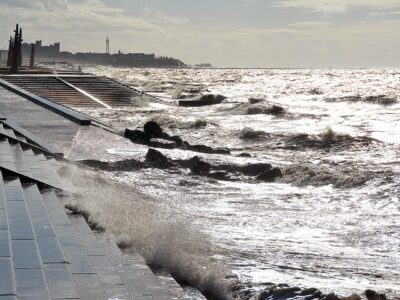
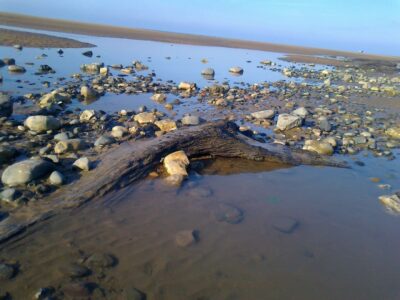
This page is about news from Cleveleys Coast Watchers. Coast Watchers is the new project where we all share information to monitor what’s happening on the shoreline in Wyre.
Monitoring Litter on Rossall Beach
Coast Watchers aims to involve people in observing, monitoring, and learning about the Fylde coastal environment.
Based on consultations with Coast Watchers volunteers, litter is something of interest and concern which emerged as important to observe and monitor. Specifically where the litter is coming from and the impact of wave and tide conditions on litter quantity and movements.
Litter is a significant human-made problem in the coastal environment. Litter is hazardous for wildlife, as it can entangle or be swallowed by various marine organisms. This is particularly true for plastic litter, which breaks down into tiny microplastics through the combined action of the sea and the sun, making it easy to enter the food chain – bad news for us humans! Litter can also affect us in other ways too, as it can negatively impact our experiences on beaches and provoke anger and disgust.
Where does the litter come from?
It’s important to manage the problem of litter on our beaches. But, to manage it, we must first understand more about it.
Through our Coast Watchers events and monthly Rossall Beach clean ups, we want to learn more about litter on Rossall beach.
- Where has the litter come from?
- How long has it been there?
- Do stormy seas increase the amount of litter on the beach?
- What processes move the litter around on the beach?
To answer these questions, our Coast Watchers group is going to start to monitor and collect data about some of the litter on Rossall Beach.
FREE Newsletter
FREE Newsletter

The survey is designed to be quick, efficient, repeatable, and easily achievable in a small team.
We’ll be collecting, recording, analysing, and weighing the litter that we find, so that we can start to understand how much litter is on the beach, where it is, and what types of litter we’re finding.
Useful Research
At monthly Rossall Beach clean ups, a section of beach will be marked out into sample areas – shown in this map.

Working in pairs, volunteers will record exactly what they find within each area. By repeating these measurements in the same place every month, we’ll build up a picture of how the litter is impacting our beach. And how other processes like storms, waves and humans are impacting the amount of litter which we find.
- It ties in with current coastal monitoring undertaken by the council to provide a ‘fuller’ picture of how the coastal environment is changing.
- Monitoring gives us a great record of beach change over time. It will add to local knowledge, tackle local issues, and answer scientific research questions.
- It’s a fun and engaging way of involving lots of people in learning about our local coastal environment.
Join in
To take part all you have to come along to the Rossall Beach Group monthly clean ups.
You’ll also notice that these notices have been put up asking you NOT to collect litter in a marked out area between the monthly events. This is to enable a more accurate record to be made of the litter.

Results from the first session
Well you couldn’t make it up! After weeks of lovely weather of course it was windy and difficult for the first monitoring session in August 2021. But volunteers steadfastly collected and noted what they picked up and these are the findings.
- 49 plastic straws
- 45 items of fishing net and rope
- 20 wet wipes
- but only 7 face masks!
Here’s a quick thought experiment. If we scaled up our results to account for the whole of Rossall beach, there’d be over 7500 pieces of litter, weighing in at over 50kg!

The September session is twice as important and interesting. Not only will litter be recorded for our own Coast Watchers project, it’s also part of the Marine Conservation Society Big Beach Clean data.
Measuring the Beach
Remember this little blue box on the seafront car park near to the cafe? It was in place during 2018/19.
It was a temporary radar station, installed to trial new equipment. The purpose is collecting data to measure and evaluate how the sand and pebbles are moving about on the beach with the effect of the tide.
It was installed on 10.5.18 by Marlan Maritime Technologies and remained in place for about 10 months. The project is in conjunction with the National Oceanography Centre, University of Liverpool and NERC.

A notice on the fence explained what it is. It says “This scientific equipment is collecting data on coastal erosion, waves and currents to help coastal engineers better protect our precious coastline and your homes from the sea.”

The gadget on top of the box is a ships radar which will measure points on the beach. It’s a self-contained unit, powered by the solar panels and wind turbine on top of the box.
As the tide comes in and out and the sand is eroded or deposited, the radar will measure how those points change. As well as the sediment, it will also collect data of how the currents and waves move in the sea. Combined with information from a tide gauge that will show us how the tides alter.
Permanent installation of radar masts
Following the trial phase, radar units are now installed at the seafront. The radar produces good quality data within a radius of about 4km. It covers a maximum radius of up to about 6km, producing less good quality data as it reaches those limits.
There’s one at the seafront at the Chatsworth entrance to the Rossall Sea Defences. Spot another one at the Plaza at Cleveleys seafront.
It’s an exciting step towards the development of the Coast Watchers project. Some interesting information should come out of it, so watch this space to find out more!
Various equipment measures all kinds of data in the coastal environment. Find out more here
Get involved with Coast Watchers
Visit Fylde Coast and Wyre Council are developing Coast Watchers, with the help of Rossall Beach Residents and Community Group.
There are different ways that you will be able to join in, from taking a photo while you’re out with your dog to helping to develop the project. Find out more at this link.
While you’re here…
What do you think? Why don’t you join in and leave a comment below?
Have a look at the Visit Cleveleys website homepage for more of the latest updates.
Love the Fylde Coast? Sign up for our weekly email newsletter. It’s packed full of interesting things and will arrive in your inbox all 52 weeks of the year.
Join us on Facebook at our Visit Fylde Coast Facebook Group
Don’t forget to follow us on Twitter @visitFyldeCoast
We Need Your Help
We Need Your Help